Showing posts with label PISA. Show all posts

Sunday, February 15, 2015

12 public education facts 'reformers' don't want you to know

In two previous posts (here, here), I discussed the ways education 'reformers' use savvy advertising and marketing to sell the unsuspecting public the notion that US schools are failing, teachers are 'bad' and unions are akin to The Walking Dead. 

How many of you have heard radio commercials for the math tutoring center, Mathnazium? For the record, I know nothing about this company. I'm not claiming they do anything other than tutor students in math. They may very well be doing an excellent job. If that's the case, more power to them. But, they are a business looking to make a profit, so their advertising has to appeal to parental fears, and make promises of success. I don't have an audio clip of their NY market radio spots, but the ones I've heard make simplistic claims about US math PISA scores—similar to the graphic below—to make it sound like our schools are failing kids in math education. 


Again, this is not a criticism of Mathnazium. They are a business, and this is what businesses do to gain market share and customers. But when state and federal governments start doing this, along with passing laws and regulations that steer taxpayer dollars to private, for-profit entities that aid in the defunding, segregation and closure of public schools, it's a whole different ball game.  

If you haven't already seen this video from The American Federation of Teachers, please stop what you're doing right now and watch. You have to click on the link. The embed function was disabled on the original. I stumbled upon it this morning on Twitter. Although it was posted over a year ago, this little gem has less than 250,000 views. It needs to go viral. It's a must-see for anyone who is concerned about standardized testing and the overall education 'reform' movement that is overtaking the US.


My hope is that after you watch it, you will stand with education professionals across the country against the myth that our schools are 'failing' and standardized testing will magically fix them.  

If for some reason you cannot access it, here's a synopsis:

Every three years 15-year-olds around the world are randomly selected to take the Program for International Student Achievment test (PISA) administered by the Organization for Economic Cooperation and Development (OECD). While the rankings may give the impression that the US education system is in dire straits, every good researcher knows that the numbers only tell us who, what, when and where; they don't tell us the all important why


Contrary to what 'reformers' would have you believe, since the test began, US PISA scores are not dropping. In fact, they have been consistently in the middle. This is where 'reformers' stop looking and listening, and start sounding the alarm bells: American schools are failing! Teachers are bad! They must be held accountable! Testing will fix it all! When in fact, the reasons the US ranks as it does are abundantly clear (but they don't want you to know)...


1. Poverty matters. In the wealthiest nation on earth, almost 1 in 4 children live in poverty. This is a national disgrace—one that 'reformers' don't want to admit, because they can't make a profit by fixing it.


2. "US schools with less than 10% poverty lead most top-performing countries with similar rates." The relationship between poverty and student achievement is well documented and irrefutable. Jersey Jazzman has written extensively about this fact, and in particular about how it relates to PISA scores
"[I]n the USA - more than any other country in the OECD - way more wealth means way larger increases in learning. 
[...] 
"[T]here is an indisputable correlation between poverty and student achievement. You can try to bad-mouth our schools all day long, but that's the fact. We have huge income inequity in this country, and it's affecting our kids. It's ridiculous to expect the schools to mitigate all of this." (emphasis mine)


3. Even at higher poverty levels, US students still outperform students in other countries who live in similar levels of poverty. That doesn't happen by magic. In NJ it took a 1985 State Supreme Court ruling to force the state to provide more resources to poor districts, and it helped. In 2010 Gov. Christie tried his best to slash funding to those same districts, but in 2011 the NJ State Supreme Court ruled against him, forcing him to fully fund the state's 31 high-need districts. Overall, Christie has underfunded public education in NJ to the tune of about $6 billion.


4. "High performing countries are doing a better job at reducing the achievement gap." Imagine what our poorer students could achieve if state and federal governments were more concerned about fixing poverty and providing our public schools with adequate resources than closing ' failing' schools? 


5. The US really doesn't spend the most on public education. When the high cost of college is removed, the US is in the middle of the pack. 


6. "The US ranks near the bottom in providing poor children equal access to quality educational materials." One need look no further than Trenton High School to see the deplorable conditions under which many high poverty students are forced to learn. And this is due to 'bad teachers'? Along with Israel, Turkey and Slovenia, the student-teacher ratio in US high poverty schools is actually greater than higher performing schools.


7. Since the Great Recession, US education spending is decreasing compared to that of other OECD nations. Only Mexico, Iceland and Ireland have cut more. Because everybody knows that the best way to improve education is to cut funding.


8. The US ranks 24th out of the OECD nations in early childhood education. Gov. Christie has called preschool 'babysitting'.
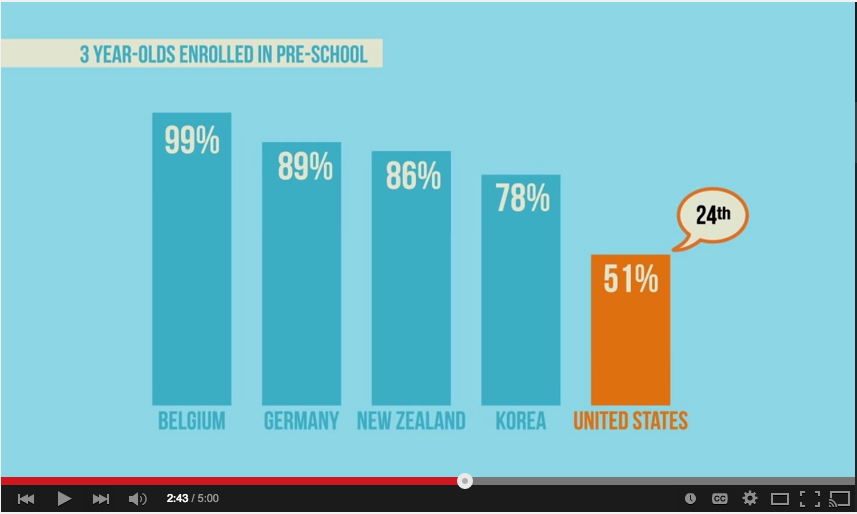


9. US teachers spend the most hours teaching and are paid far less than other PISA countries. Teachers in Finland, one of the PISA leaders, spend far less time teaching. 


10. In other high-performing countries, teachers are paid for the work that US teachers bring home and do on their own time. 


11. OECD says the claim that other countries have better teachers because they are recruited from the top 1/3 of college graduates is "not supported by evidence." What is evident is that these countries respect educators and give them extensive time to hone their craft and collaborate. 


12. Unions are not the problem. In fact, the highest performing countries have excellent working relationships with their teacher unions.


So, the next time a 'reformer' tries to tell you that a test, a voucher, a charter school, an evaluation system, a school closure, a drastic cut to education funding, a 'rigorous' curriculum, or a right-to-work or anti-union law will magically transform your child's school, just ask them to show you the facts. Then sit back and listen...


Monday, May 5, 2014

Happy Teacher Appreciation Week: How China and the US are swapping education philosophies

UPDATE! After a good night's sleep I dug some more and found a terrific article from The Atlantic that I incorporated in this post. 

Chinese students are saddled with enormous amounts of homework.

Early on in my teaching career I taught elementary art in the Bernards Township School District in Somerset County. The township is about 83% white with the largest minority being Asian at 14%. With a median family income of $153,000 and poverty below 3%, the children don't want for much. Many parents take an active role in their children's education, encouraging and even demanding they be involved in several after school activities. They expect the schools to offer top-notch curriculums including the arts, foreign languages, plenty of AP classes, sports and extracurricular programs because they pay top dollar in property taxes and they want their children to attend excellent colleges and universities. And the schools deliver.

US News and World Report gave the only high school in the district, Ridge High School, a gold medal in its annual rankings of US high schools. It placed 177th in the country overall, 7th in the state, 136th in the country for STEM education, with almost 100% of its students proficient in math and language arts, and a College and Career index of 65%.

This is an excellent school fed by excellent elementary and middle schools.

My story is about a 3rd grade girl whom I taught there. I don't remember her name, but she was Chinese American. Her father worked at one of the big pharmaceutical companies for which New Jersey was once famous. (Many are pulling up stakes and leaving the state.) She was very bright and eager to please.

She was done with her project and was doing some free drawing when it was time to clean up. She begged me to let her finish her drawing. I couldn't let her stay because I had another class coming in. She was really pushing me on this. When I suggested she take it home and finish it, she told me she couldn't; she didn't have any time. I jokingly told her I found that hard to believe, to which she replied, "I have no time at home. I have violin lessons and soccer practice after school, then I go to Chinese school Saturday mornings, and I do that homework on Sundays."

I was shocked. This child was 8 or 9 years old and had that much of a work load. She clearly had little time for play or creative thinking and being. But as my teaching career progressed, I came in contact with more students like her—and not just students of Asian or Indian descent. I have seen plenty of Caucasian students whose parents are so fixated on academic success that they push their children to the point of exhaustion.

So does China—but not in what education professionals in the US consider a healthy way. The Chinese education system is a highly competitive group activity with the teacher clearly in control. Students sometimes spend more than 10 hours a day in school and have enormous amounts of homework starting in first grade. If an individual student in a Chinese classroom is struggling, the teacher and the other students work together to help him or her. Teachers are greatly respected and pay no income taxes. College entrance exams, the gaokao, are an all-or-nothing event. As this article  The Atlantic written by Helen Gao, a Chinese immigrant who came to the US in her junior year in high school describes: 


Sitting for nine hours over two days, students are tested on everything from Chinese and math to geography and government. The intense, memorization-heavy, and notoriously difficult gaokao can make the SAT look like a game of Scrabble. How they do on the test will play a big role in determining not just where they go to college but, because Chinese colleges often feed directly into certain industries and fields, what they do for the rest of their life. It's an enormously important moment in any Chinese student's life, which is part of why high schools here dedicate months or even years to preparing for the test. (emphasis mine)

If a student fails the exam—the only criteria for getting into a college—their educational career is basically over. Once they are admitted, they must pass a high stakes test to advance to the next grade. This is an extremely stressful time in the life of not only the student, but the entire family because oftentimes the hopes of several generations rest on this one student. Because of limited space, only about 1/3 of all students in China will be admitted to institutions of higher learning. 

But all this testing comes at a cost. Gao continues:


China's gaokao-style education system has been great at imparting math and engineering, as well as the rigorous work ethic that has been so integral to China's rise so far. But if the country wants to keep growing, its state economists know they need to encourage entrepreneurship and creativity, neither of which is tested for on this life-determining exam. (emphasis mine)

...


I was used to strictly formatted Chinese argumentative essay topics, for which I had memorized hundreds of paragraphs that I could organize like jigsaw puzzles. Western-education-style papers on, for example, the significance of symbols in a novel was not the sort of expressive, creative thinking for which my Chinese teachers had prepared me. 

In the US, public education focuses on the whole child. A struggling student will get more individualized or small group instruction. Teachers are encouraged to be facilitators of learning rather than the sole source. Hands-on, kinesthetic, differentiated, brain-based and whole child teaching and learning are the norm. The best teachers will teach students to think creatively, experiment and take risks; to work to their individual potential. Building healthy self esteem is just as important as teaching academic subjects. Children are given many and different chances for success, even if they drop out of school. College is looked at as a means rather than a means to an end. And as for educator salary and respect, well, if you're reading this, you don't need me to tell you how fantastic they are.

A quick Google search of the differences between the Chinese and US education systems resulted in many articles with the words 'bad', 'unequal', 'expensive' or 'mediocre' in their titles. I passed them by. But I did find this interview of two former Chinese students. The female guest was educated in New Zealand. Her parents moved her out of China because they wanted to give her a better, more diverse education. Notice at the 3:50 mark when talking about her mother's education in Taiwan she says, "You're taught to take tests; not necessarily how to think."


The host then continues by saying, "I think that's becoming more of a thing in the US... Now it does very much seem like it's all about tests." And at about the 4:30 mark, the male guest says, "In China if you have a photographic memory and you can memorize a textbook, then you'll do really well." He goes on to say that in China, education is everything. Parents drill the value of hard work and a good education into their children's heads from a very early age.

But while it's more than admirable that China places such a high value on education (something more American parents must do) and produces some of the top test takers in the world, they have yet to produce a Nobel Prize winner. The country's overemphasis on wrote memorization, drill and skill and standardized tests leaves little room for creativity, independent thinking and kinesthetic learning, things about which the world leader in Nobel Prize winners—the United States—knows a great deal.

But that tide is turning. According to a report in the New York Times:


The United States State Department does not break down its data on visas by age and school type, but anecdotal evidence here suggests that increasing numbers of middle-class families are looking for a way out of China’s test-taking gantlet.


“I didn’t want my son to become a book-cramming robot,” said 15 year old Zhang Ruifan’s mother, Wang Pin, explaining why she sent him to live and learn halfway across the world in the United States. American educators and politicians have been warning for years that rising powers like China and India are poised to overtake the United States in science achievement. On a 2009 standardized test that drew worldwide attention, students in Shanghai finished first in the sciences among peers from more than 70 countries, while the United States came in 23rd (right behind Hungary).
However, as Diane Ravitch points out, according to research (you know, that little something reformy types fail to acknowledge), "The U.S. has never been first in the world, nor even near the top, on international tests. Over the past half century, our students have typically scored at or near the median, or even in the bottom quartile." (emphasis mine)

The Times article continues:


But even many Chinese educators are dismayed by the country’s obsession with stellar test results. Last fall they convened a conference on the topic in Shanghai.


“When American high school students are discussing the latest models of airplanes, satellites and submarines, China’s smartest students are buried in homework and examination papers,” said Ni Minjing a physics teacher who is the director of the Shanghai Education Commission’s basic education department, according to Shanghai Daily, an English-language newspaper. “Students also have few chances to do scientific experiments and exercise independent thinking.”
... 
The ministry said the systemic fixation with testing “severely hampers student development as a whole person, stunts their healthy growth, and limits opportunities to cultivate social responsibilities, creative spirit, and practical abilities in students.” (emphasis mine)


So, as China realizes the value of creativity and self expression in education, the United States is moving toward more and more standardized high stakes testing. As school budgets all across the country are slashed and total emphasis is placed on passing standardized tests, phys-ed, art, music, library, computer, foreign language and other related arts programs are being scaled back or eliminated. The cost to the United States will be incalculable because entire populations of learners are being marginalized. The creative side of education, the art of teaching and the joy of learning—things the US excels at—will die unless educators fight to save them.

And as high stakes consequences are increasingly tied to high stakes tests, it won't be long before US teachers go the way of Chinese teachers. In China, Gao says, "Teachers and headmasters, whose reputations and salaries are tied to their students' exam scores, have more of an interest in maintaining a good average than in, say, dedicating extra time to a struggling student."

Before humans spoke they created art. Humanity cannot exist without creativity. Great public education won't either.


Sunday, March 23, 2014

Rally for NJ Public Education Part 3: ‘Bad Teachers’ & ‘Failing Students’ are the WMDs of Ed 'Reform'


Thirteen years ago, after the horrific attacks of 9/11, the Bush/Cheney/Condi triumvirate sold the nation on a war based on a lie: that Iraq had weapons of mass destruction and was connected to the terror attacks. Even after it was proven they didn’t have WMDs and the terrorists were Saudis—not Iraqis—Bush and Company plowed on, squandering our budget surplus, putting billions on the nation’s credit card in hopes of gaining control of Iraq’s oil reserves, and sacrificing the lives of thousands of brave young men and women in the process.

In 2011 I visited the Washington, DC office of the late Sen. Frank Lautenberg—a WWII veteran—to talk to him about education policy. Outside his office was a display called “Faces of the Fallen": 

"... a memorial to the service members who lost their lives in Afghanistan and Iraq. Begun in 2004, the memorial… consists of more than 100 placards, each containing the pictures, names, ages, hometowns and causes of death of service members who sacrificed their lives to serve our country.” It was, to say the least, a moving and humbling tribute to so many brave men and women who made the ultimate sacrifice for our country. 


While President Bush was perpetrating that lie on a shell-shocked nation, he was cooking up another one: failing students. More recently accompanied by ‘bad teachers’, these two phrases have become the WMDs of the war on public education. They have been manufactured and sold to the general public by business people and elected officials—both Republican and Democrat—in order to cash in on the $600 billion education industry despite the fact that there is an enormous amount of data generated by the US government and researchers from a variety of public and private enterprises that says the problem in America isn’t public education, but poverty.

While President Obama and Education Secretary Arne Duncan were wringing their hands over the US scores on the 2010 PISA (Program for International Student Assessment), Diane Ravitch actually analyzed the data and debunked the Chicken Little myth:

“American students in schools with low poverty… had scores that were equal to those of Shanghai and significantly better than those of high-scoring Finland, the Republic of Korea, Canada, New Zealand, Japan and Australia… the scores of students in low-poverty schools in the United States are far higher than the international average, higher even than the average for top-performing nations, and the scores decline as poverty levels increase, as they do in all nations.” (Reign of Error, p.65) (Emphasis mine.)

American schools are not 'failing', the sky is not falling, but the ability of many Americans to provide for their families is. 

But why look at messy things like facts when rhetoric is so much easier to sell and profit from? While school district budgets across the country are being slashed, those same districts must come up with thousands, and in some cases, millions of dollars to pay for technology and other upgrades to prepare for the onslaught of standardized testing despite no proof that it will improve student learning!

As the assault on public education marches on, two glaring ironies are emerging:
  • While ‘reformers’ push for more ‘accountability’, testing, and standards for our kids, theirs go to elite private schools with low student-teacher ratios, rich curriculums, shorter school days and years, and no punitive accountability measures. 
  • As educator/blogger Mercedes Schneider reports, the long overemphasis on standardized testing in other countries is backfiring as they graduate more and more students who are excellent at test taking, but who lack critical, creative, and higher order thinking skills: “Asian countries do better than European and American schools because we are ‘examination hell’ countries,” said Koji Kato, a professor emeritus of education at Tokyo’s Sophia University. “There is more pressure to teach to the test. In my experience in working with teachers the situation is becoming worse and worse.”

Click here for the answer.
Be sure to read Schneider’s entire post. It’s a veritable primer on the ultimate goal of education ‘reform’.

So again I ask: What will you do to help stem the tide of education ‘reform’? I know where I’ll be on March 27th. I’ll be in Trenton with people from all across the state fighting to take back our classrooms from profiteering carpetbaggers. Please join us!